

Bail Bond Cost in Houston: Fees, Premiums, Collateral & Payment Plans
When dealing with an unexpected arrest in Harris County, calculating the total financial cost is the first step toward bringing your loved one home. In Houston, the standard rate charged by licensed surety agents typically ranges between 10% and 15% of the total bail amount set by a magistrate judge.
Under Texas law, an arrested individual must appear before a magistrate for a formal bail setting hearing “without delay and no later than 48 hours” following booking. Once that bail figure is established—whether it is $2,500 for a misdemeanor or $50,000 for a serious felony—you can calculate the required premium.
To understand how this translates into actual numbers across common bail tiers in Harris County:
- $2,500 Total Bail: At a standard 10% rate, your out-of-pocket premium is $250.
- $10,000 Total Bail: A typical 10% to 15% rate requires a premium between $1,000 and $1,500.
- $50,000 Total Bail: A 10% premium equals $5,000, and bonds at this level frequently require collateral to secure the underlying financial risk.
It is critical to remember that this premium is a non-refundable fee for service. The bail bondsman assumes 100% of the financial liability with the court system, guaranteeing that the defendant will attend every required court date. Because the agency takes on the risk of the entire bond amount and performs the administrative work to execute the release, that fee is fully earned once the jail accepts the bond.
Once a bond is posted at the Harris County processing facility, the realistic release timeline generally spans 4 to 24 hours. Misdemeanor releases often process on the faster side (4 to 12 hours), while complex felony charges or peak intake hours can take 12 to 24 hours. At 24/7 Bail Bonds, we provide clear pricing and around-the-clock service across Harris County to ensure your paperwork is processed without administrative delays.
What Are the Differences in Cost Between Cash, Surety, and Personal Bonds in Harris County?
Choosing how to post bail in Houston involves weighing immediate out-of-pocket costs against long-term financial risk. The Harris County criminal court system recognizes three primary bond mechanisms: Cash Bonds, Surety Bonds, and Personal Recognizance (PR) Bonds.
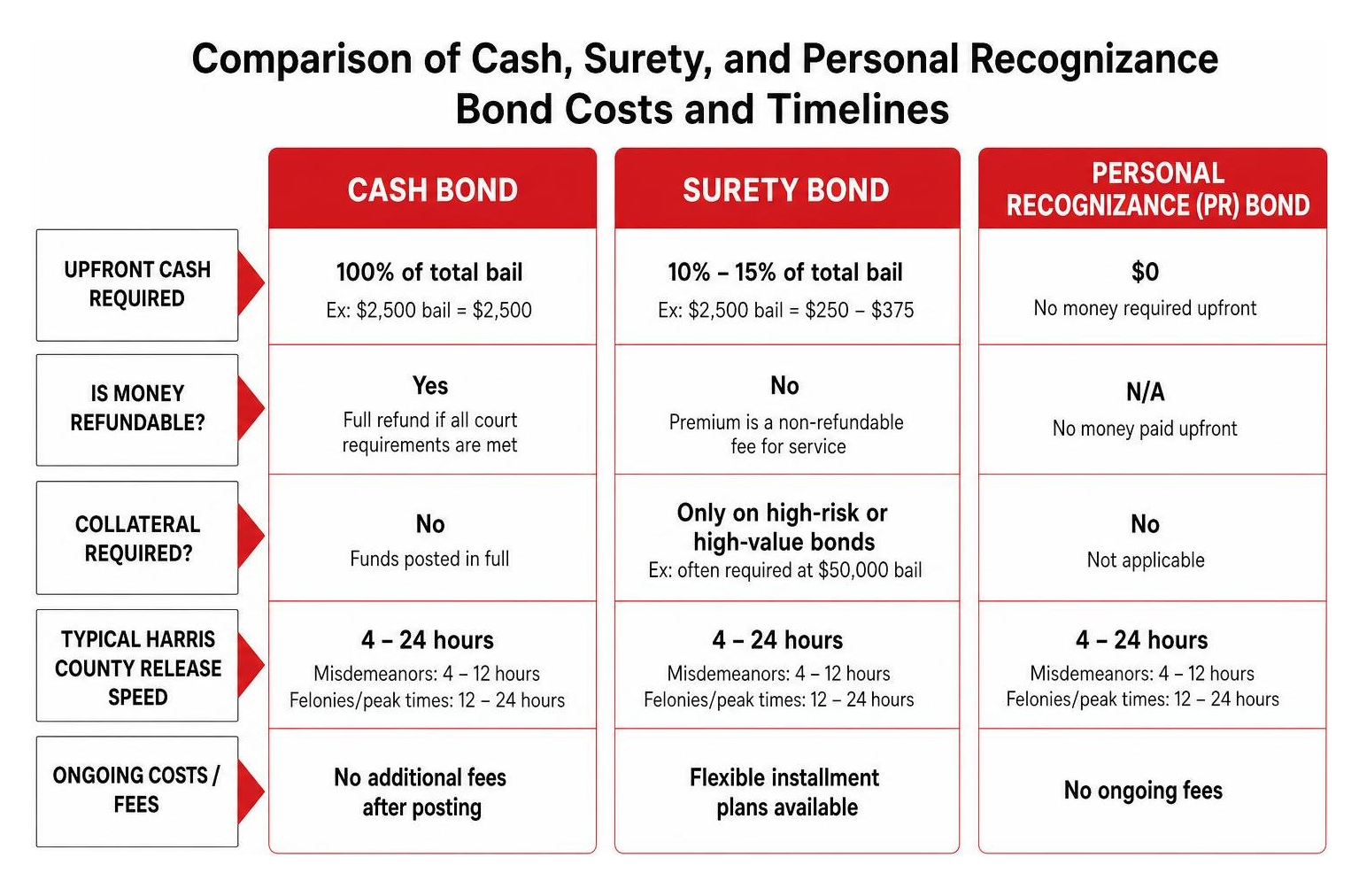
The table below outlines the core financial and procedural differences between each bond type:
| Bond Type | Upfront Cash Required | Is Money Refundable? | Collateral Required? | Typical Harris County Release Speed | Ongoing Costs / Fees |
|---|---|---|---|---|---|
| Surety Bond | 10% – 15% of total bail | No (non-refundable fee) | Only on high-risk or high-value bonds | 4 – 24 hours | Flexible installment plans available |
| Cash Bond | 100% of total bail | Yes (minus court fees, fines, & restitution) | No (cash is the collateral) | 6 – 24 hours | Administrative processing deductions |
| Personal Bond (PR) | $0 (or small county statutory fee) | N/A | No | 12 – 48 hours | Monthly supervision, drug testing, GPS rental fees |
When processing releases through the Harris County 1200 Jail, understanding these mechanisms ensures you do not lock up critical family capital unnecessarily.
Cash Bonds vs. Surety Bonds
A cash bond requires depositing the full face value of the bail directly with the court clerk or jail intake desk. If a judge sets bail at $20,000, you must deliver the entire $20,000 via cash, cashier’s check, or approved money order.
While cash bonds are theoretically refundable at the conclusion of the case, they carry significant financial drawbacks:
- Capital Lockup: Your funds remain frozen with the county for the duration of the criminal proceedings, which often take twelve to twenty-four months in Harris County criminal courts.
- Mandatory Deductions: Before any refund is issued, the court clerk automatically deducts court costs, administrative filing fees, mandated state surcharges, and any restitution ordered by the judge.
- Refund Delays: Receiving a refund check from county financial offices after final case disposition can take several months.
Opting for a surety bond preserves your liquid savings. By paying a 10% premium ($2,000 on a $20,000 bail), your family keeps the remaining $18,000 liquid to hire a private defense attorney, manage living expenses, or maintain household stability.
Personal Recognizance (PR) and Pretrial Supervision Fees
A Personal Recognizance (PR) bond allows a defendant to be released on their promise to appear without posting upfront commercial surety capital. While this option appears free at first glance, PR bonds in Harris County often come with substantial recurring costs through Pretrial Services:
- GPS Electronic Monitoring: Mandatory ankle monitor rentals often range from $150 to $350 per month.
- Supervised Drug & Alcohol Testing: Mandatory urinalysis or SCRAM alcohol monitors can cost $10 to $30 per test.
- Supervision Administrative Fees: Routine check-in and administrative charges assessed by county pretrial supervision departments.
Furthermore, magistrates frequently deny PR bonds for defendants with prior felony convictions, active warrants, out-of-county holds, or charges involving violent allegations, making commercial surety bonds the primary pathway to securing release.
How Do Houston and Harris County Ordinances Regulate Bail Bond Premiums?
Bail bond operations in Texas are strictly governed at both the county and municipal levels to maintain ethical practices, financial stability, and public safety.
In Harris County, licensed bail bond agencies are regulated by the Harris County Bail Bond Board pursuant to Chapter 1704 of the Texas Occupations Code. This board oversees licensing requirements, monitors financial reserves—mandating that corporate and individual sureties maintain collateral deposits with the county—and enforces consumer protection standards under the Texas Deceptive Trade Practices Act.
A major regulatory benchmark is the Houston City Council bail bond ordinance, which establishes a mandatory minimum 10% premium on bail bonds written for specific serious violent and sexual offenses.
The ordinance applies directly to offenses detailed under the Texas Penal Code, including:
- Murder and Capital Murder
- Aggravated Kidnapping
- Aggravated Robbery
- Trafficking of Persons
- Sexual Assault and Aggravated Sexual Assault
- Continuous Violence Against the Family
Regulatory Impact on Pricing and Documentation
Before this ordinance took effect, some agencies offered discounted down payments of 2% or 3% on high-level felonies. In response to criminal court backlogs exceeding 100,000 cases, municipal and county leaders enacted these strict pricing rules to eliminate reckless underwriting and ensure defendants have a genuine financial commitment to attending their court hearings.
Under these regulations:
- Strict Fee Floor: No bail bond agent operating within Houston municipal jurisdiction may discount premiums below 10% for qualifying violent offenses.
- Sworn Affidavits Required: Bondsmen must execute sworn legal affidavits and maintain detailed accounting records proving that the full statutory premium was assessed and scheduled.
- Prohibition of Deceptive Terms: Hidden financing charges, misleading fee structures, and undisclosed service fees are strictly prohibited.
These rules protect consumers from predatory lenders while establishing clear, uniform pricing across the Houston metropolitan area.
When Is Collateral Required and What Types Are Accepted?
Collateral serves as a secondary financial guarantee held by the bail bond company to protect against the catastrophic loss of a forfeited bond. Because a bail agency assumes liability for the complete bond amount (the other 85% to 90% that you did not pay upfront), collateral is requested when an underwriting assessment indicates elevated risk.

Houston bail bond companies evaluate several risk indicators when deciding whether to require collateral:
- Bond Size: Bonds set at $50,000 or higher almost universally require physical collateral or strong indemnitor backing.
- Severe Flight Risk: Defendants with past histories of Failure to Appear (FTA), bail jumping, or active warrants in other jurisdictions.
- Residency and Community Ties: Out-of-state residency, transient living situations, or lack of established employment history in the Greater Houston area.
- Severity of Charges: First-degree felonies, high-dollar financial fraud, or major narcotics charges that carry lengthy mandatory minimum prison sentences.
Accepted Forms of Collateral in Harris County
When collateral is necessary, bondsmen accept tangible, verifiable assets that can be legally secured and evaluated:
- Real Estate Equity: Residential homes, commercial properties, or vacant land within Texas. The property must have sufficient unencumbered equity (often valued at 1.5 to 2 times the total bail amount). Proof of current property taxes and paid homeowners association (HOA) dues is required.
- Vehicle Titles: Cars, trucks, motorcycles, or commercial vehicles with clean, clear titles (no outstanding bank liens) registered with the Texas Department of Motor Vehicles.
- Certificates of Deposit (CDs) & Bank Accounts: Assigned cash-equivalent instruments or pledged deposit accounts.
- Jewelry and Precious Metals: Gold, fine jewelry, or certified precious stones, typically assessed at conservative wholesale pawn or liquidation value.
All pledged collateral is held securely in escrow under a formal bail collateral agreement. Once the defendant’s case reaches a final legal conclusion—whether through dismissal, acquittal, a plea agreement, or sentencing—the court enters an official disposition exonerating the bond. Upon presentation of the certified court disposition paperwork, the bail bond company is legally required to return all pledged collateral intact to the depositor.
Collateral Forfeiture Risks
If a defendant fails to appear in court, a magistrate issues an immediate capias warrant for their arrest and initiates a civil legal proceeding known as a Judgment Nisi (bond forfeiture).
Before liquidating collateral, reputable agencies work closely with families during a statutory grace period to locate the defendant, address missed court notices, and re-docket the case before the court. However, if the defendant willfully absconds and cannot be surrendered to the court, the bond agency must pay the full face value of the bail to the county clerk. At that point, the agency exercises its legal right to liquidate the pledged collateral to cover the court judgment and associated recovery expenses.
How Do Bail Bond Payment Plans Work in Houston?
Posting bail is rarely an expense families plan for in advance. When an unexpected arrest occurs and the upfront premium exceeds your available cash, structured bail bond payment plans bridge the financial gap.
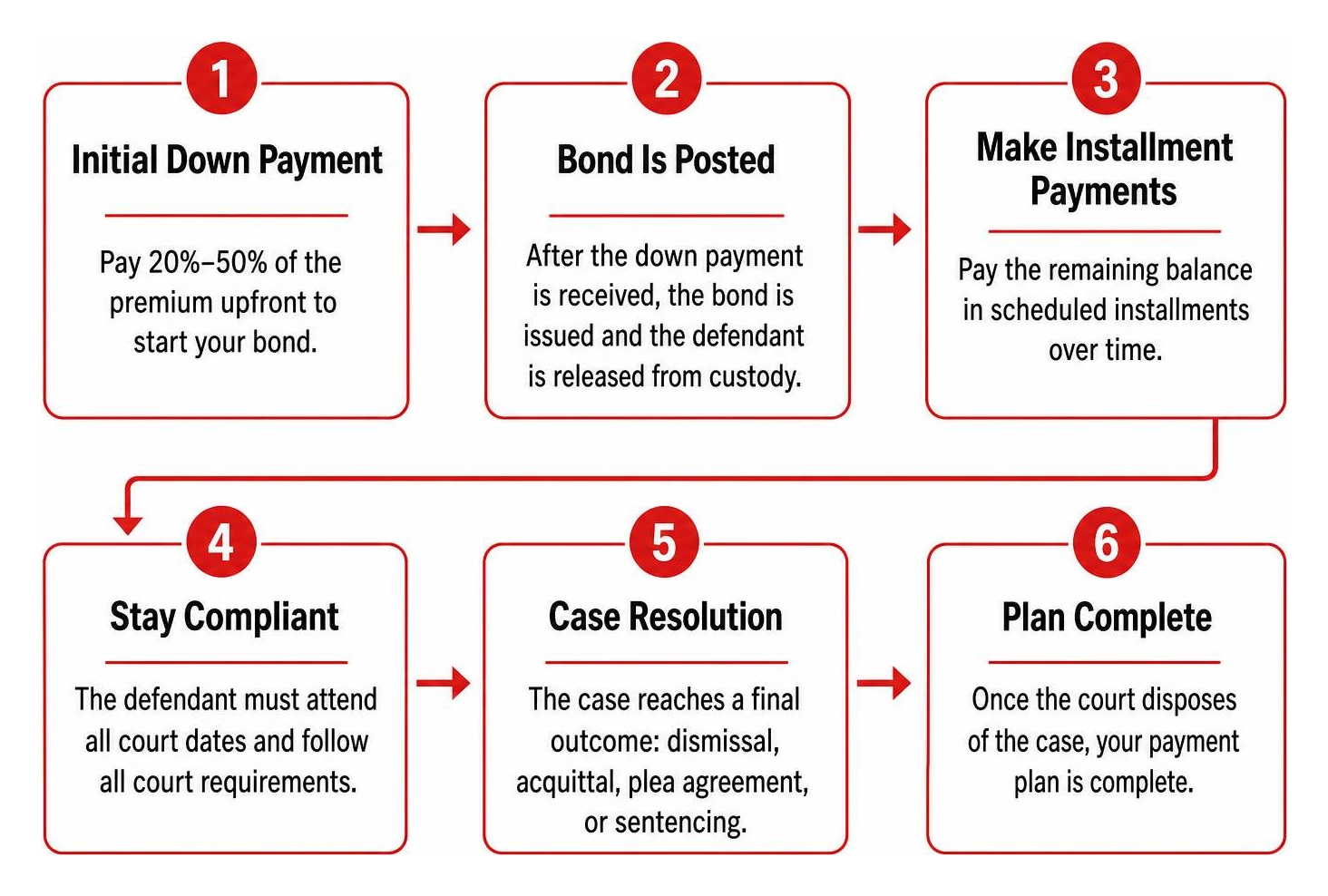
A reliable payment plan allows you to secure immediate release from custody by paying an initial down payment, followed by manageable installment payments over time.
Structuring a Compliant Payment Plan
In Harris County, flexible financing typically follows a straightforward framework:
- Initial Down Payment: Most agencies require a down payment ranging from 20% to 50% of the total premium fee before the bond is posted at the jail. For example, on a $1,000 premium, an initial payment of $200 to $500 is collected upfront.
- Installment Schedules: The remaining balance is split into weekly, bi-weekly, or monthly payments that align with the cosigner’s payroll schedule.
- 0% Interest Financing: Reputable bail agencies structure these installment contracts with zero-interest financing, ensuring you pay only the agreed-upon statutory premium without ballooning finance charges.
- Cosigner Backing: A qualified cosigner (indemnitor)—such as a family member or close friend with verified local employment and stable residency—signs the financing agreement, guaranteeing that installment payments will be completed.
Under Harris County Bail Bond Board rules, every payment arrangement must be documented in a written time-payment contract signed prior to bond execution. This contract explicitly lists the total premium, down payment collected, remaining balance, and exact due dates, preventing hidden fees or surprise collections.
Working with an experienced, licensed Harris County bail bond agency ensures you receive honest terms, zero hidden fees, and clear paperwork tailored to your budget. Understanding these financing mechanisms alongside the standard Harris County arrest-to-release procedures allows your family to navigate the justice system with confidence.
What Are the Most Common Questions About Houston Bail Bond Costs?
No, the premium paid to a bail bond agency is completely non-refundable, regardless of what happens to the criminal case.
The premium is a fee charged for the service of securing the defendant’s immediate release from jail and guaranteeing the full bail amount to the Harris County court. The moment the jail processes the bond and discharges the individual from custody, the bondsman has fulfilled their contractual obligation, and the fee is fully earned. Whether the District Attorney dismisses the charges the next morning, a grand jury issues a “no bill,” or the case proceeds to a full jury trial, the premium cannot be returned.
Note: This rule applies only to the premium fee. Any physical or cash collateral deposited with the bondsman remains 100% refundable once the case is concluded.
What extra administrative or processing fees can a bondsman charge?
In addition to the standard 10% to 15% premium, certain situations may involve incidental administrative costs, which must be clearly disclosed in your initial contract:
- State & County Filing Fees: Small statutory court filing fees (typically $15 to $40) assessed by the county clerk to process surety paperwork.
- Electronic Monitoring Setup Fees: If the magistrate orders GPS or SCRAM alcohol monitoring as a condition of bond, installation and monitoring vendor fees apply.
- Out-of-County Warrant Processing: Long-distance administrative verification or transfer fees if the defendant has holds in neighboring counties (such as Fort Bend, Montgomery, or Brazoria).
- Credit Card Surcharges: Standard merchant processing fees (usually 2% to 3.5%) if paying premiums via credit card.
Reputable agencies maintain absolute transparency and will never introduce surprise administrative fees after the bond has been posted.
What happens financially if the defendant misses a court date?
Missing a court date in Harris County triggers serious financial and legal consequences for both the defendant and the cosigner:
- Bond Forfeiture (Judgment Nisi): The judge declares the bond forfeited and issues an immediate warrant for the defendant’s arrest.
- Full Bail Liability: The cosigner (indemnitor) and the bail agency become legally liable to the county for the 100% face value of the bail—not just the premium. If the total bail was $25,000, the cosigner is responsible for that entire $25,000 balance.
- Collateral Liquidation: Any real estate, vehicle titles, or cash deposits pledged to secure the bond are subject to liquidation to satisfy the court’s judgment.
- Recovery and Legal Fees: The cosigner becomes financially responsible for investigative, recovery, and court costs incurred to locate and re-arrest the defendant.
If an unavoidable emergency occurs (such as hospitalization or an auto accident), contacting both your bail bondsman and your defense attorney immediately allows us to file a motion to reinstate the bond before a final forfeiture judgment is entered.
How Can You Secure Fast and Affordable Bail in Houston?
Navigating an arrest in Houston is stressful, but understanding bail costs removes the uncertainty from the process.
To recap the core financial considerations:
- Expect Standard Rates: Plan on a non-refundable surety premium between 10% and 15% of the total bail set by the magistrate judge.
- Know the Law: Understand that Houston municipal ordinances legally mandate a strict minimum 10% premium for serious violent or sexual charges.
- Protect Your Capital: Use surety bonds to avoid locking up tens of thousands of dollars in cash with the county clerk during lengthy court proceedings.
- Utilize Structured Financing: Take advantage of 0% interest payment plans starting with low down payments to ease immediate financial strain.
- Safeguard Collateral: Ensure your indemnitors understand court obligations so that pledged property and vehicle titles are returned safely upon case resolution.
When a loved one is held at the Harris County 1200 Jail, every passing hour matters. At 24/7 Bail Bonds, our licensed bail agents are available 24 hours a day, 7 days a week, 365 days a year. We handle all types of bonds—including misdemeanor, felony, DWI, traffic, immigration, and federal cases—with rapid, confidential service and customized payment plans designed for your budget.
Contact our team right now for immediate assistance, transparent pricing, and fast jail release across Harris County.