
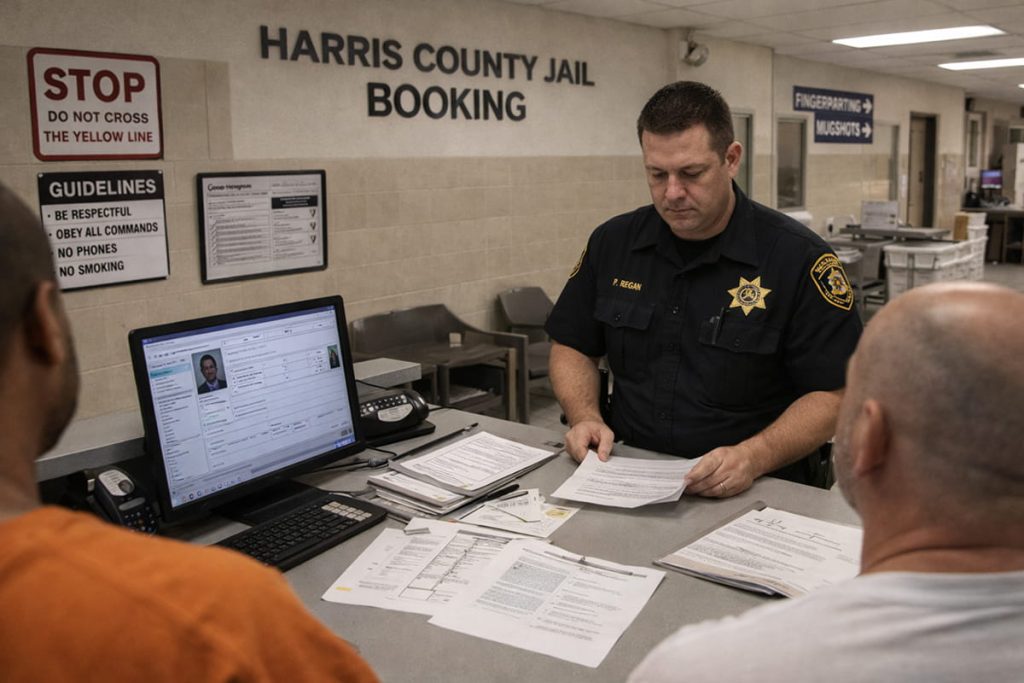
What Are the Different Types of Bail Bonds Available in Harris County?
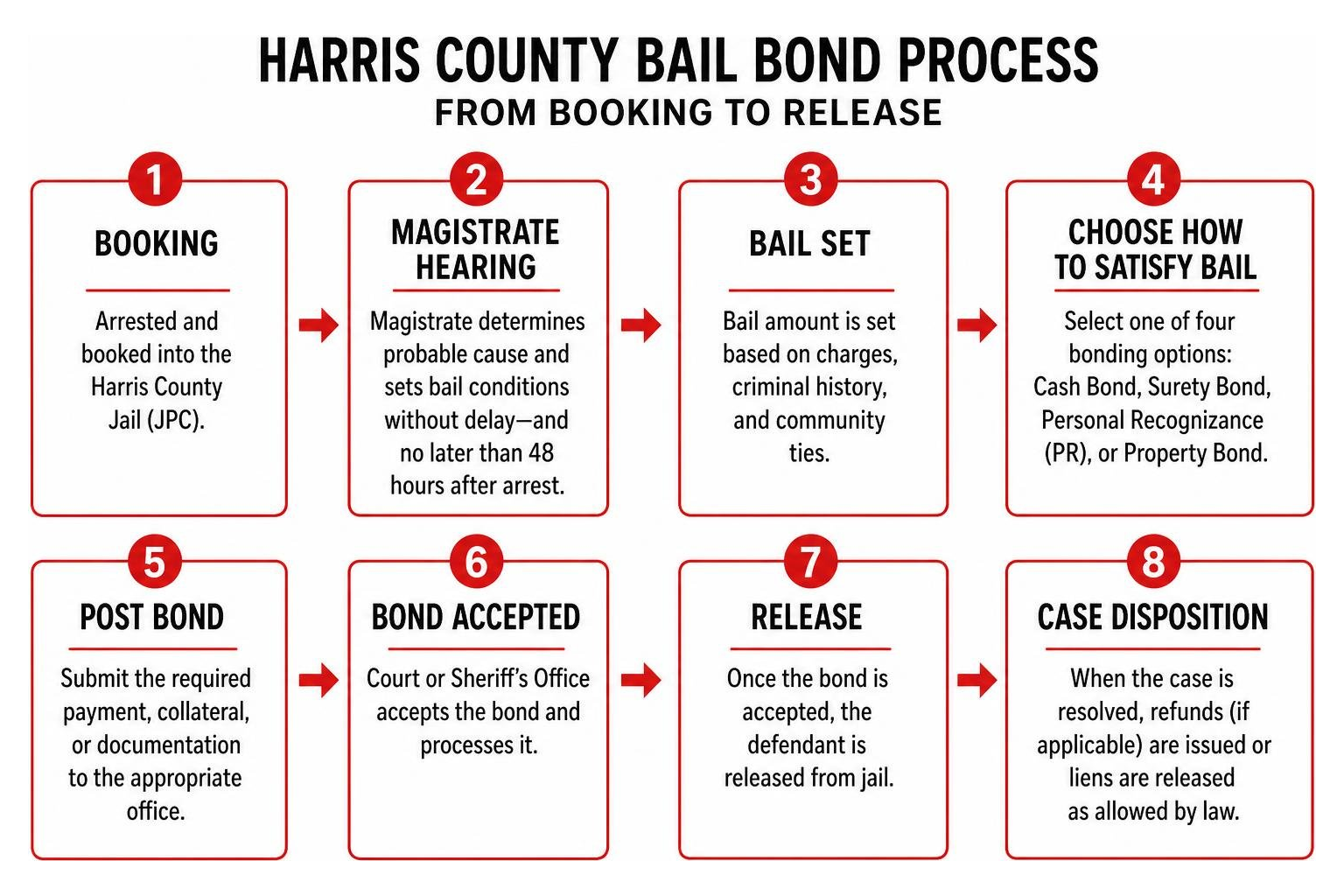
To post bail for an inmate in Harris County, obtain the defendant’s System Person Number (SPN) and exact bail amount, decide between paying a full cash bond or hiring a licensed surety agency (typically charging a 10%–15% premium), and submit payment in person 24/7 at the Joint Processing Center (700 N. San Jacinto St.) or remotely via approved payment portals. Under the Texas Code of Criminal Procedure, a magistrate must set bail conditions without delay—and no later than 48 hours after arrest.
During this initial hearing, a magistrate reviews the charges, the defendant’s criminal history, and community ties to determine a financial bail amount. Depending on whether the alleged offense is a class B misdemeanor, a domestic charge, a DWI, or a serious felony, bail amounts in Harris County typically range from $100 to over $75,000.
It is essential to understand the distinction between bail and a bond:
- Bail is the total monetary amount set by the court that the defendant must guarantee to secure temporary release while their case is pending.
- Bond is the legal instrument or contract (such as cash, a surety undertaking, or pledged property) deposited with the court to satisfy that bail requirement.
Harris County recognizes four primary bonding mechanisms. The table below outlines how each option compares across cost, collateral, speed, and refund eligibility:
| Bond Type | Upfront Out-of-Pocket Cost | Collateral Required? | Processing Speed | Refund Eligibility |
|---|---|---|---|---|
| Cash Bond | 100% of the total bail amount | No | Moderate (depends on cashier window queues) | Yes (100% minus a 5% county fee up to $50) |
| Surety Bond | 10%–15% non-refundable premium | Sometimes (for high-risk or high-dollar felony bonds) | Fast (bypasses direct cash lines via electronic posting) | No (premium serves as the agency’s earned service fee) |
| Personal Recognizance (PR) | $0 upfront (statutory administrative fees apply upon disposition) | No | Slower (requires Pretrial Services interview and judge sign-off) | Not applicable |
| Property Bond | Recording, title, and appraisal filing fees | Yes (real estate valued at 1.5x–2x the bond amount) | Slowest (requires several days for title search and valuation) | Yes (lien is released upon case disposition) |
Cash Bonds
A cash bond requires you to deposit the full face value of the bail amount directly with the Harris County Sheriff’s Office or the District Clerk. If a judge sets bail at $5,000, you must provide the full $5,000 upfront.
The county accepts cash, cashier’s checks, and United States Postal Service money orders payable to the Harris County Sheriff’s Office. When you post a cash bond, no commercial bail agent is involved. Once the criminal case concludes—whether through dismissal, acquittal, or sentencing—the depositor receives a refund of the principal amount, minus a mandatory statutory administrative fee deducted by the county.
Surety Bonds
When paying the full cash bail out of pocket is financially unfeasible, a surety bond is the standard alternative. You contract with a licensed bail agency that agrees to post the full bail amount on the defendant’s behalf, guaranteeing to the court that the defendant will attend every scheduled hearing.
In exchange for assuming this financial risk, the bail agency charges a state-regulated premium, typically between 10% and 15% of the total bond amount. For example, on a $10,000 bond, the premium usually runs between $1,000 and $1,500. This premium is earned upon release and is non-refundable.
For standard bonds, a financially stable cosigner (indemnitor) is required. For higher-risk or larger felony amounts, agencies may request additional collateral, such as clear vehicle titles or real estate. Working with an experienced local agency like 24/7 bail bonds enables families to complete electronic paperwork remotely and post bonds around the clock, significantly speeding up the release timeline.
Personal Recognizance (PR) and Pretrial Release Bonds
A Personal Recognizance (PR) bond—often referred to as a Pretrial Release bond—allows a defendant to be released on their written promise to appear in court without having to pay upfront cash collateral.
In Harris County, Pretrial Services conducts risk-assessment interviews with defendants shortly after booking. Staff evaluate the individual’s employment, family ties in the Houston area, criminal background, and history of court appearances. If deemed low-risk—frequently seen in first-time, non-violent misdemeanor cases—a magistrate may grant a PR bond.
While no upfront cash security is collected for the bond principal, Texas law allows the county to assess a nominal administrative fee upon final disposition. Additionally, PR bonds carry strict conditions, including regular check-ins with a pretrial officer, mandatory drug testing, and travel limitations.
Property Bonds
A property bond allows an individual to pledge unencumbered real estate located within Texas as collateral to satisfy bail. Harris County enforces stringent guidelines on property bonds:
- The equity in the pledged property must equal at least 1.5 to 2 times the total bail amount.
- All listed owners on the property deed must execute the bond documents in person.
- The depositor must present an original certified deed, an updated title search showing no liens or back taxes, and an official appraisal from the Harris Central Appraisal District (HCAD).
Because county attorneys must verify deeds, evaluate tax statements, and record liens against the title before approving release, property bonds often take several business days to process. As a result, they are rarely used when an immediate release from jail is required.
Where and How Can You Post Bail for an Inmate in Harris County?
Harris County operates one of the largest municipal jail systems in the United States. Inmate intake, processing, and holding are distributed across key downtown facilities:
- The Joint Processing Center (JPC) at 700 N. San Jacinto St. (the central intake hub)
- The 1200 Jail at 1200 Baker St.
- The 711 Jail at 711 N. San Jacinto St.
Before attempting to post bond, you must verify three critical details: the inmate’s full legal name, their SPN (System Person Number), and their exact bond amount. You can confirm this information through the county’s public intake registry or by reviewing the official inmate bonding guidelines from the Harris County Sheriff’s Office.
In-Person Posting at 700 N. San Jacinto
The central bonding desk for Harris County is open 24 hours a day, 7 days a week, 365 days a year. It is located on the ground floor of the Joint Processing Center at 700 N. San Jacinto Street, Houston, TX 77002.
To post cash bail in person:
- Enter the public lobby at 700 N. San Jacinto and check in with security.
- Approach the bonding window and provide the clerk with the inmate’s SPN, date of birth, and formal case number.
- Present your valid government-issued photo identification. Depositors must be at least 18 years of age.
- Provide payment. Cashier’s checks and money orders must be made out for the exact amount to the Harris County Sheriff’s Office. Cashiers do not make change for cash overages.
- Review the official bond contract, sign as the depositor, and collect your validated payment receipt. Retain this receipt securely—you will need the original document and case number to claim your refund when the case concludes.
Posting Bond Online and Remotely
If you cannot travel to downtown Houston, Harris County accepts remote card payments through approved third-party platforms such as GovPayNow (AllPaid).
To pay online, you will need the specific Pay Location Code (PLC) for the Harris County facility holding the defendant, along with the inmate’s SPN and cause number. That third-party processing companies charge non-refundable credit/debit card surcharges (typically ranging from 3% to 7%), and single-transaction daily limits may prevent you from paying larger bail sums online.
Once an online payment processes, the system generates a digital tracking authorization code. You must monitor the transaction until the JPC cashier verifies the funds and moves the inmate’s file into the discharge queue. To avoid transaction caps or technical processing delays, many families choose licensed bail agencies to execute electronic bonds remotely via direct agency portals.
Facility-Specific Bonding Procedures
While all initial intakes are processed through the central hub, different housing locations involve distinct logistical steps:
- Joint Processing Center (JPC): Most newly arrested individuals are booked here. If you are handling bail during the initial intake window, check the Harris County Joint Processing Center bail instructions to ensure the magistrate has formally signed the bond schedule before submitting payment.
- The 1200 Jail: Inmates transferred to long-term housing at the 1200 Baker Street facility follow specific release routes. For defendants housed here, review the Harris County 1200 Jail bail and bond information regarding property releases and transportation pick-up zones.
- The 711 Jail: For individuals held in secondary downtown annexes, consult the Harris County 711 Jail bail and bond information to verify window hours and visitor access guidelines.
What Are the Costs, Deductions, and Refund Timelines in Harris County?

Understanding the financial side of the bail system helps prevent unexpected costs. Every bond type carries distinct financial obligations, non-refundable expenses, and recovery procedures for depositors and cosigners (indemnitors).
Cash Bond Administrative Deductions and Refunds
When you post a cash bond directly with Harris County, the primary advantage is that the principal amount is refundable once the criminal case is fully resolved. However, the refund is subject to specific statutory conditions:
- Statutory Administrative Fee: Under Texas Local Government Code § 117.055, the county clerk is required to deduct an administrative fee of 5% of the total cash bond amount, capped at a maximum fee of $50.00. The remaining 95% (or full amount minus $50) is returned to the original depositor.
- Processing Timeline: Cash bond refunds are not issued on the day the case ends. The Harris County District Clerk’s Office processes refunds within an average window of 6 to 8 weeks following the entry of a final judgment, dismissal, or acquittal.
- Address Updates: The refund check is mailed directly to the name and address listed on the original cash bond receipt. If you move while the case is ongoing, you must submit a formal, notarized Change of Address form to the District Clerk’s Office.
- Elimination of Assignments: The Harris County District Clerk no longer accepts third-party cash bond assignments. The refund check can only be issued to the specific depositor named on the initial jail receipt.
Surety Bond Premiums and Financing
When working with a commercial bail agency, the premium you pay is a service fee for the agency putting up the full financial guarantee with the court.
- State-Mandated Rates: Bail bond premiums in Texas are standardly set between 10% and 15% (most commonly 10% to 12% for state charges). This fee is fully earned once the inmate is released from custody and is completely non-refundable, regardless of whether charges are dropped the following week.
- Payment Plans: For higher bond amounts, licensed agencies frequently offer structured financing. Cosigners typically put down an initial percentage (such as 3% to 5%) and finance the remaining premium balance through interest-free monthly installments.
- Indemnitor Liability: As a cosigner, you agree to indemnify the bonding company. If the defendant skips court, the cosigner becomes legally responsible for paying the entire face value of the bond plus any recovery expenses incurred.
- Avoiding Bail Scams: Be cautious of unsolicited phone calls from individuals claiming to be jail employees or deputies demanding immediate money transfers via peer-to-peer payment apps (such as Zelle, Venmo, or wire transfers) to secure a loved one’s release. Legitimate jail personnel will never call demanding direct app transfers. Always verify bond amounts through official county channels.
Requesting a Bail Reduction Hearing
If the magistrate sets an unaffordable bail amount, the defendant is not necessarily stuck. Under Texas Code of Criminal Procedure Article 17.15, bail cannot be used as an instrument of oppression.
A defense attorney can file a formal Motion for Bond Reduction or an Application for Writ of Habeas Corpus, requesting a reduction hearing before a district or county court judge. During this hearing, the judge evaluates several factors:
- The nature and severity of the charged offense.
- The defendant’s financial resources and ability to make bail.
- Family and community ties within Harris County.
- Past criminal history and compliance record during prior court proceedings.
- Future safety of the community and the alleged victim.
If the judge finds the original bail excessive, they may lower the monetary bond or replace financial conditions with pretrial supervision requirements.
What Should You Expect After Posting Bond and During Pretrial Release?
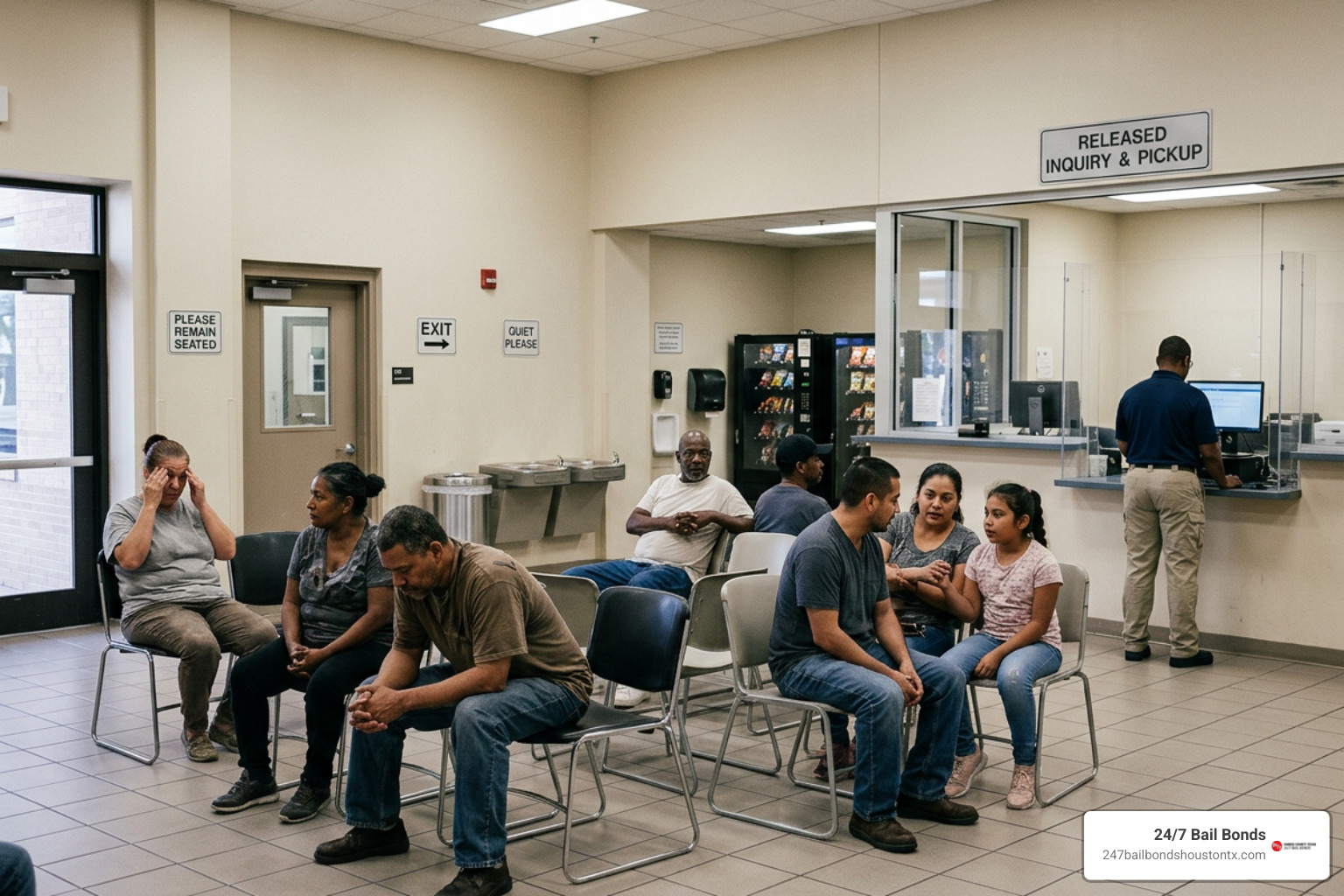
Many families assume that an inmate will walk out of the facility the moment the bond receipt is printed. In reality, physical discharge involves an extensive administrative and operational process.
Once the bond is processed at 700 N. San Jacinto, the discharge paperwork enters the jail’s internal system. The typical release timeframe in Harris County ranges from 2 to 8 hours. The exact duration depends on:
- Verification that the defendant has no active warrants or holds from other Texas counties, municipalities, or federal agencies (such as ICE or the U.S. Marshals).
- Completion of final biometric identity verification (fingerprint exit scans).
- Retrieval and inventory reconciliation of personal property, clothing, and funds stored during initial booking.
- Administrative shift changes and peak intake hours within the Joint Processing Center.
Upon discharge, the individual exits through the main public lobby at 700 N. San Jacinto Street, where they receive their personal belongings and an official court notice outlining their initial appearance date, courtroom number, and presiding judge.
Pretrial Supervision and Bond Conditions
Release on bond is conditional. While awaiting trial, defendants must strictly comply with all conditions imposed by the court and monitored by Harris County Pretrial Services.
Common bond conditions include:
- Court Appearances: Appearing on time for every scheduled docket call, arraignment, pre-trial conference, and trial date.
- Lawful Behavior: Committing no new criminal offenses while out on bond.
- Substance Monitoring: Submitting to random drug and alcohol screenings.
- DWI Specifics: Mandatory installation of an ignition interlock device on any motor vehicle operated by the defendant, particularly for repeat offenses or high blood-alcohol readings.
- Protective Orders: Adhering to strict “No Contact” orders involving alleged victims in domestic violence or assault allegations.
- Travel and Curfew Restrictions: Remaining within Harris and contiguous counties unless granted written permission to travel by the court, often enforced through electronic GPS ankle monitors.
Failure to follow any condition can prompt the prosecutor to file a Motion to Revoke Bond, resulting in an immediate warrant and re-arrest without the option for a new bond.
Consequences of Failing to Appear (Bond Forfeiture)
Failing to appear in court triggers serious legal and financial consequences:
When a defendant misses a mandatory hearing:
- The judge immediately revokes the bond and issues a Capias (bench warrant) for their arrest.
- The court enters a preliminary civil judgment known as a Judgment NISI (judgment unless), declaring the entire bond amount forfeited unless the defendant and surety show good cause for the absence within statutory deadlines.
- If the bond was secured through a commercial agency, the agency’s recovery team will work to locate and surrender the defendant back into custody.
- If a cash bond was deposited, the court seizes the entire cash deposit, permanently forfeiting the funds to the county treasury.
- Cosigners on surety bonds become immediately liable for the full face value of the bond, in addition to court costs and attorney fees.
Frequently Asked Questions About Harris County Bail Bonds
How long does it take for an inmate to be released after bond is posted in Harris County?
The release process in Harris County generally takes between 2 to 8 hours after the bond is officially accepted at the window. Delays frequently occur due to facility-wide shift changes, system-wide warrant clearance checks across local, state, and federal databases, peak intake volumes at the Joint Processing Center, or pending medical evaluations. If an inmate has an out-of-county detainer or an immigration hold, release from county custody may be paused pending transfer to the requesting agency.
Who is legally eligible to post bail for someone in Harris County Jail?
Any individual who is at least 18 years old and possesses a valid, unexpired government-issued photo identification card (such as a Texas Driver’s License, out-of-state ID, passport, or military ID) can post a cash bond for an inmate.
To post a surety bond, you must either work through a commercial bail bond agent licensed by the Harris County Bail Bond Board or qualify as an authorized personal surety approved by the court. An attorney representing the defendant on the criminal matter cannot act as a commercial surety on their client’s bond unless they are separately licensed under county bail regulations.
Can you get your bail money back if the charges are dropped or dismissed?
Yes, if you posted a cash bond directly with the court. Once the case is formally dismissed, the judge issues an order releasing the bond, and the District Clerk returns the full deposited amount minus the statutory 5% administrative fee (capped at $50).
If you secured release through a surety bond, the 10% to 15% premium paid to the bail bond company is an earned, non-refundable service fee. That premium is not returned when charges are dismissed, as it covers the agency’s operational costs and financial risk assumption during the period the defendant was out on bail.
How Can You Get Fast, 24/7 Bail Assistance in Harris County?
Navigating the criminal justice system in Houston can feel overwhelming, especially during the crucial 48-hour window following an arrest. Securing a prompt release protects a defendant’s employment, family stability, and ability to work effectively with defense counsel.
To post bond as quickly as possible:
- Locate the defendant using the Harris County Sheriff’s Office online inmate portal to obtain their correct legal name, date of birth, and 8-digit SPN.
- Confirm the exact bond amounts and charges associated with each cause number.
- Decide whether a direct cash bond or a surety bond best fits your current financial situation.
- If using a surety bond, choose a licensed agency that operates 24/7 and offers transparent terms and flexible payment plans.
At 24/7 Bail Bonds, we provide fast, around-the-clock bail bond assistance across all Harris County detention facilities, including the Joint Processing Center, the 1200 Jail, and the 711 Jail. Our experienced agents handle felony, misdemeanor, traffic, and specialized bonds with clear, upfront pricing and responsive local support. Contact our team 24 hours a day to start the release process immediately.